
As we dissect the 2025 media landscape, a consequential paradox has emerged. On paper, the industry has never been more efficient. We have discovered 948 vendors (and counting) offering to automate everything from the "first frame to the last mile." We’ve seen Tier-1 operators like GMA Network and FanCode report staggering cost reductions in distribution and encoding. And yet, if you look at the macro-economic health of the Media & Entertainment (M&E) sector, the much-anticipated "AI-driven growth explosion" compounded with AI-driven OPEX savings remains elusive.
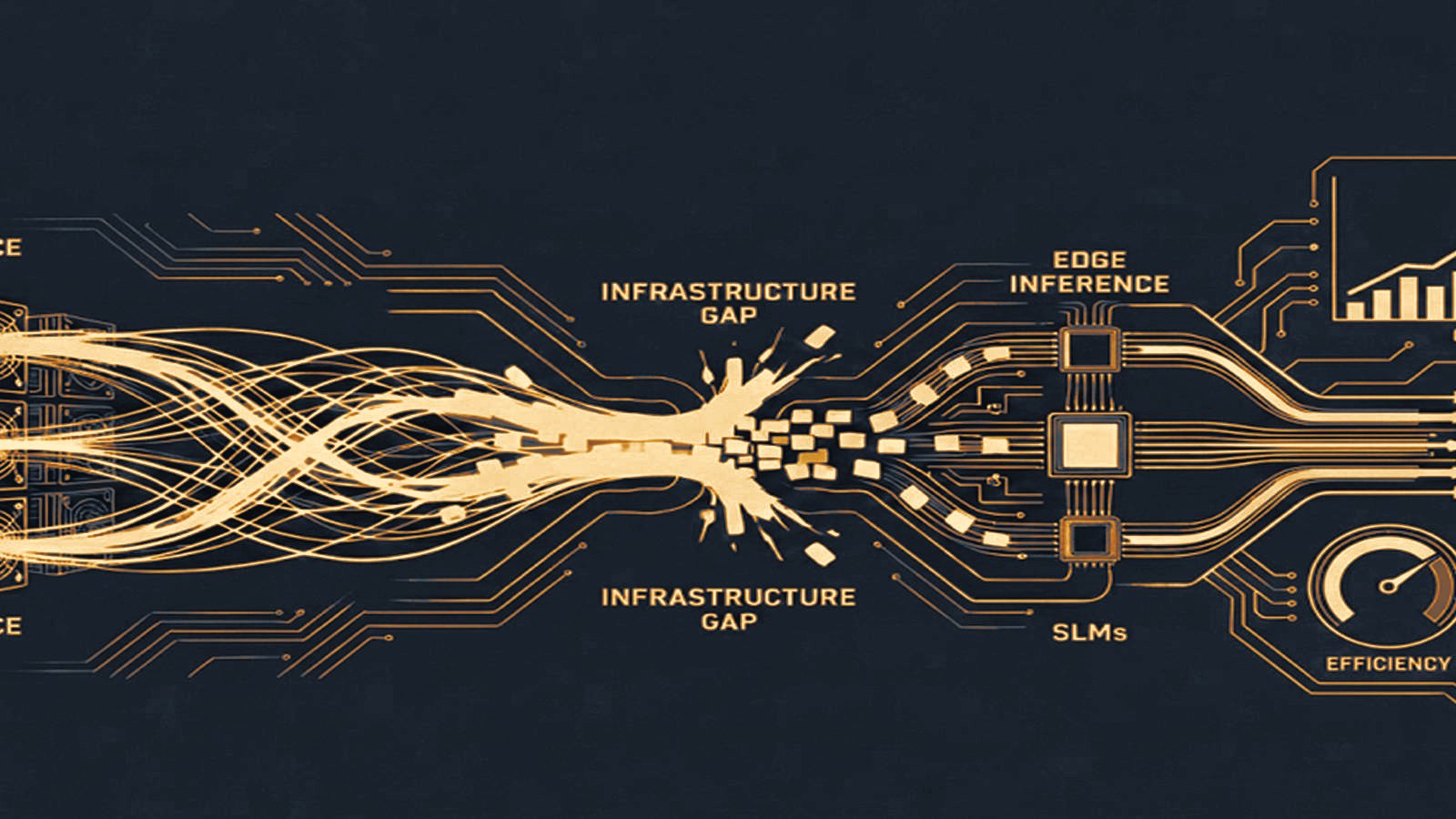
Why? Because the industry is currently trapped in the Infrastructure Gap. While we’ve successfully used AI to pick the "low-hanging fruit" of productivity, we haven't yet bridged the gap between cutting costs and creating new wealth. What is yet to be seen is if the cost of replacing legacy workflows with AI-based workflows will bring any major savings, or simply reshuffle the budget.
The "Plumbing" Problem: Variable vs. Fixed Costs
For thirty years, the M&E industry was built on a foundation of fixed infrastructure costs—heavy Capex investments in satellite transponders, playout centers, and massive hardware-based broadcast chains. While the industry has widely adopted cloud-first consumption models (SaaS, PaaS, IaaS), those traditional "aaS" models were predictable.
In 2025, AI-native workflows shifted that paradigm toward variable compute costs that can be wildly unpredictable. Initially, many organizations found that the immediate savings from reducing manual labor were offset by the high OPEX of cloud GPUs and "brute-force" AI API tokens—effectively trading a human payroll for a "Compute Tax." However, this is a transitional friction point. When optimized, AI has the proven potential to lower OPEX significantly and accelerate processes by 10x or more.
We are already seeing the proof in the field: Netflix reported a 10x speedup in VFX completion for El Eternauta, while other global solution owners have documented 100 hours of translation work completed in just 10 minutes using AI video platforms. Even in marketing, AI-generated content is now roughly 4.7x cheaper than human-written alternatives. The current stagnation in the bottom line isn't a failure of AI’s potential; it’s a symptom of inefficient compute usage that 2026's shift toward optimized inference will finally resolve.
The Interoperability Tax
Our TML AI² Research shows a highly fragmented vendor landscape. Most media organizations are running "Frankenstein workflows"—stitching together disparate AI "islands" like Moments Lab for enrichment and SDVI for orchestration. These tools often don't "speak" the same data language, creating a new category of "hidden labor."
Until we move toward unified Agentic Orchestration, the true economic potential will remain locked. This is why we are advocating for a unified M&E AI taxonomy and standardized protocols. A leading example is the Ad Context Protocol (adcontextprotocol.org), which provides a universal, open-source grammar for agent-to-agent (A2A) interaction. Its mission is to move past the "dashboard chaos" of manual integrations, allowing buyer and seller agents to negotiate directly on outcomes rather than just impressions.
To achieve true scalability, the industry must replicate this mission by developing similar AI-first protocols for content metadata and supply chain hand-offs. Without a shared technical infrastructure that allows machines to "understand" one another without human translation, innovation will remain siloed and the "Compute Tax" will continue to eat the ROI.
Contextual Advertising: A Paradigm in Wait
A perfect example of this infrastructure friction is Dynamic Ad Insertion (DAI) using video sentiment and contextual targeting. While it promises extreme granularity, the AI-associated costs to run such a sophisticated scheme—analyzing every frame for sentiment—often make the business model too complex compared to "bullet-proof" SCTE-35 markers. We believe AI will bring a major paradigm change to the ad industry as a whole, but it will likely be a 2026 story once the cost of "looking" at the video matches the value of the "ad slot."
The ROI of "Good Enough" vs. "Great"
2025 taught us a controversial lesson: High-end AI isn't always cheap, and cheap AI isn't always good. The failure of Amazon Prime Video’s AI Recaps proved that "black box" AI without a rigorous human-curated safety net leads to brand risk.
This brings up a critical warning: are we going to choke our own processes? With AI, we can generate tons of information at lightspeed, but if we spend all our saved time validating that output, the "Verification Layer" becomes a ceiling on growth. The key is not to generate more just for the sake of it, but to use AI agents to verify quality and predict customer behaviors at the same pace as the generation.
The Actionable Path Forward: Efficiency at the Edge
To move back into growth, we must stop using AI inefficiently. Today, many media processes are handled by "brute-force" LLMs—an expensive and wasteful use of resources. The path forward is Tailor-made Smaller Inference Models (SLMs).
By moving away from massive cloud-dependent models toward specific, high-performance models running on-prem or at the edge, we can:
-
Offload the CDN: Using AI-predictive caching and compute-at-the-edge to make delivery more efficient.
-
Maintain Sovereignty: Running "tiny" models locally eliminates the security risk of sending IP to a public cloud.
-
Lower the "Compute Tax": Smaller models require less power and fewer tokens, finally allowing the OPEX savings to hit the P&L.
Conclusion
The Infrastructure Gap is a natural phase of any industrial revolution. 2025 was about proving that the pipes work. 2026 will be about increasing the pressure. We’ve spent twelve months ensuring business continuity; now, we must focus on business expansion by making our "plumbing" as smart and efficient as the content it carries.
Coming Next in the AI2 Playbook Series:
Stay tuned for our final installment, Article 6: 2026 Predictions – The Rise of Agentic Media, where we look at how the "Media Factory" evolves into an autonomous, self-optimizing engine.
The AI2 Playbook: Navigating the Media Transformation
This article is part of a comprehensive 6-part series on the state of AI in Media & Entertainment, featuring the strategic vision and 2026 roadmap of Fernando Amendola alongside the specialized operational deep dives of Thierry Fautier. Explore the full series below to navigate our 1000-vendor research and the industry's path forward.
Explore the Full Series
-
2025 AI in M&E, a Retrospective View: The Year of Stealth Transformation – By Fernando Amendola
-
2025 AI in Content Providers: Productized Creativity – By Thierry Fautier
-
2025 AI in Broadcasters: Trust, Scale, and Monetization – By Thierry Fautier
-
2025 AI in Pay TV Operators: Strategic Restraint – By Thierry Fautier
-
The M&E AI Infrastructure Gap: The ROI Paradox – By Fernando Amendola
-
AI in M&E 2026 Predictions: The Rise of Agentic Media – By Fernando Amendola
About The Media League: Insights-as-a-Service
At The Media League, we believe the time for defensive posture is over. We are walking the talk by evolving our own consultancy into a fully AI-integrated, Insights-as-a-Service platform.
Beyond our deep-dive research, we are currently architecting a specialized, M&E-first autonomous agent. This project compiles the collective wisdom of "Leaguers" and industry thought leaders into a single, seamless interface—designed to provide you with frictionless access to high-value market intelligence while eliminating traditional consulting barriers.
Stay tuned for our AI2 Enquire agent, set for a special preview at NAB 2026, as we move from delivering reports to empowering you to query the future of media in real-time.