
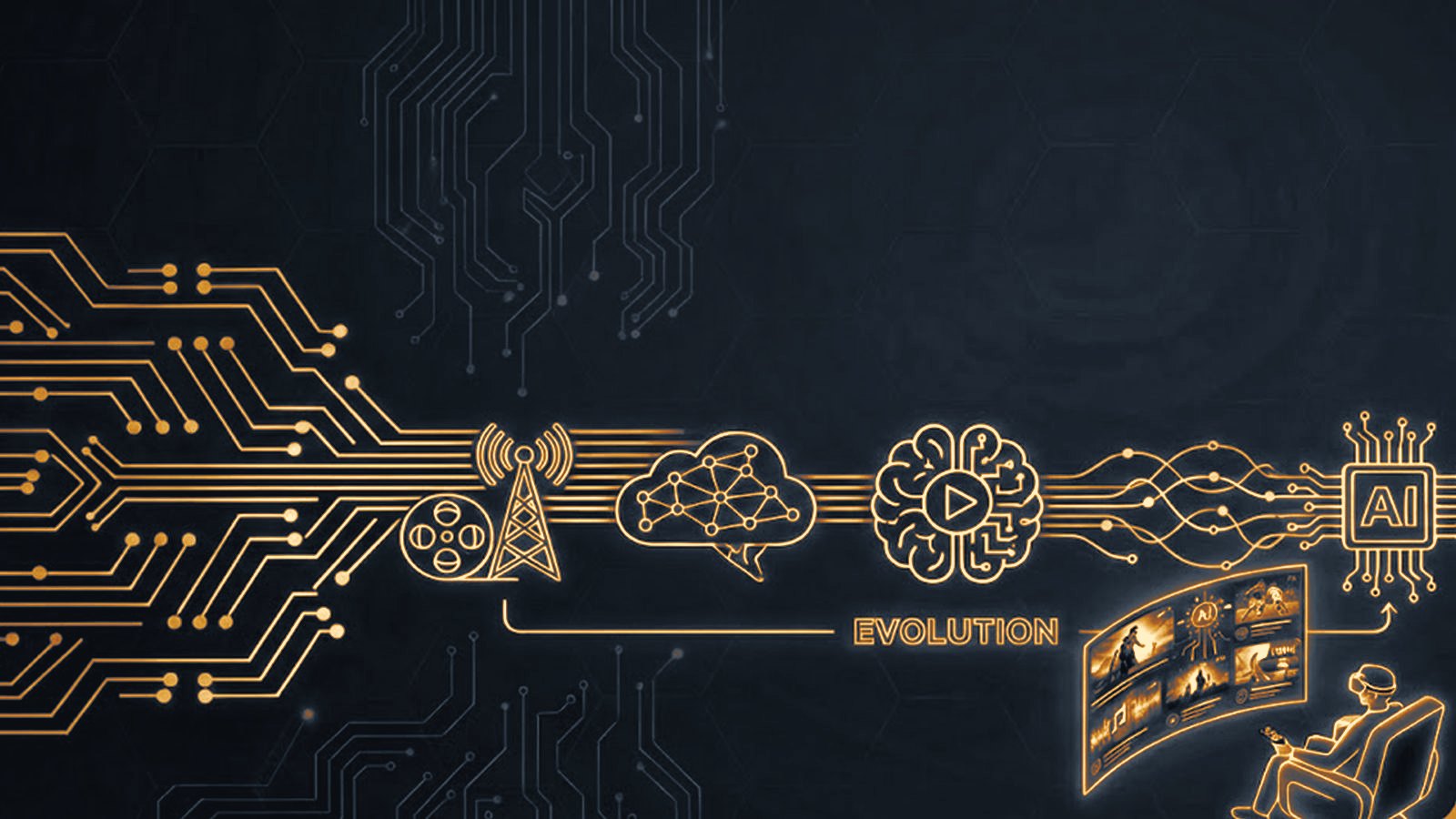
As we close the books on 2025, it’s clear we aren't just looking at a "tech trend" in the rear-view mirror; we are witnessing the first ripples of a deep, tectonic transformation in the Media & Entertainment (M&E) industry. This past year has been characterized by a cautious yet determined "testing of the waters." Most organizations have focused on incorporating AI into existing workflows—tweaking the pipes rather than replacing the plumbing—to ensure business continuity while exploring the possibilities.
However, don't let the measured pace fool you. 2025 was the essential warm-up; 2026 is poised to be the year where these legacy structures are set aside in favor of entirely AI-native workflows that rethink the industry from the ground up.
"2025 was the essential warm-up; 2026 is poised to be the year where legacy structures are set aside in favor of entirely AI-native workflows."
Our The Media League AI2 Research has uncovered a vibrant and rapidly maturing ecosystem, identifying 948 unique companies currently offering AI solutions and services specifically for the M&E sector. The current market distribution reflects a heavy investment in the "Media Factory":
-
CONTENT CREATION: 33% (VFX, Visual Analysis, Non-GenAI Production)
-
EXPERIENCE ENRICHMENT: 25% (Metadata, Localization, Orchestration, QC)
-
VIDEO DELIVERY: 23% (CDN, Ad-Tech, Security, Ad Insertion / Monetization)
-
USER ENGAGEMENT: 19% (Analytics, Discovery, Interactive, Commerce)
As we continue to dig deeper, we anticipate the number of serious contenders will reach the 1,200 mark as new AI-native startups enter the fray. However, we expect a natural stabilization around the 1,000 mark as M&A activity picks up and industry hyperscalers begin to "suck the oxygen" out of the room, potentially choking out smaller, single-solution vendors.
EXPERIENCE ENRICHMENT: AI-Generated, Human-Curated Metadata
In 2025, we finally stopped pretending that humans could keep up with the sheer volume of global content. The paradigm shifted from manual logging to a collaborative model where AI does the heavy lifting and humans provide the editorial oversight. This "AI-generated, human-curated" approach has turned deep archives into active, searchable assets.
"The paradigm shifted from manual logging to a collaborative model where AI does the heavy lifting and humans provide the editorial oversight."
A standout success in this space was the partnership between Moments Lab (formerly Newsbridge) and the French broadcaster TF1. By deploying multimodal AI that understands context and emotion, TF1 was able to index massive volumes of footage, allowing editors to find specific "needle-in-a-haystack" moments in seconds. Similarly, Lionsgate partnered with Runway to train a private LLM on its 20,000-title library, solving copyright risks associated with open models while providing creative teams with a brand-safe storyboarding engine.
The Reality Check: Warning signs are flashing for organizations attempting to build proprietary "RAG" (Retrieval-Augmented Generation) systems without specialized media infrastructure. Several mid-tier broadcasters reported that internal models hallucinated metadata, creating "ghost" assets and licensing risks. Without a rigorous curation layer, automated tagging can quickly become a liability.
CONTENT CREATION: Automated Highlights and the Narrative "Soul" Gap
The most significant field action in the "CREATE" pillar involved high-volume automation for sports and the surprising arrival of "Final Pixel" GenAI in scripted television.
In a landmark moment for VFX, Netflix utilized GenAI for final on-screen effects in the drama El Eternauta. Collaborating with Eyeline Studios, they produced a complex building-collapse sequence 10 times faster than traditional methods, completing a shot that was previously "beyond the project's budget." On the sports side, WSC Sports and DAZN teamed up to manage over 100 concurrent events for the FIFA Club World Cup, proving that for repetitive, high-volume tasks, AI is now the undisputed champion.
The Reality Check: High-stakes storytelling remains a hurdle. Amazon Prime Video launched X-Ray Recaps (via Bedrock) to solve "previously on" fatigue. While a significant step forward in fan engagement, the deployment faced immediate scrutiny from dedicated fanbases for its "monotone" delivery and occasional struggles with narrative nuance. It serves as a reminder that while AI can compile highlights, it still lacks the narrative "soul" that a human editor provides for emotional storytelling.
"While AI can compile highlights, it still lacks the narrative 'soul' that a human editor provides for emotional storytelling."
VIDEO DELIVERY: Dismantling the Satellite with "Demand-Sensing" Pipes
AI moved to the network edge in 2025 to dismantle the high "delivery tax" that has long burdened global operators.
GMA Network in APAC delivered a consequential blow to traditional models by replacing satellite distribution with Synamedia’s AI-driven "demand-sensing" cloud model, resulting in a 22–25% reduction in distribution costs. In India, FanCode achieved a 40% data reduction on mobile networks using Visionular’s content-adaptive AI encoding. These aren't just features; they are prerequisites for economic survival in price-sensitive markets.
"These aren't just features; they are prerequisites for economic survival in price-sensitive markets."
The Reality Check: Operators should be wary of the "Codec Trap." While AI-based predictors for VVC (Versatile Video Coding) promised massive bandwidth savings, a fragmented device landscape meant many served "perfect" files that a significant portion of their audience couldn't actually decode, leading to high fallback costs.
USER ENGAGEMENT: From "Choice Paralysis" to Guided Intention
2025 was the year "Engagement" finally started behaving like "Revenue." We moved from guessing what users liked to reacting to what they were seeing in real-time.
NBCUniversal deployed an internal AI suite to identify live sports "triggers"—like a fumble—to deploy relevant ads instantly. Simultaneously, Netflix replaced keyword search with an LLM-driven "Responsive Discovery" system, shifting from "listing content" to "guiding intent." This convergence of contextual metadata and ad-tech has redefined the industry's monetization baseline.
The Reality Check: "AI-driven Echo Chambers" are becoming a churn risk. Operators who leaned too heavily on purely automated recommendation engines without a diversity-weighted algorithm reported spikes in "content fatigue." When AI only feeds a user what they’ve already seen, the "discovery" element disappears, and platform stickiness declines.
"When AI only feeds a user what they’ve already seen, the 'discovery' element disappears, and platform stickiness declines."
2025 IN REVIEW: The Foundation for a Radical 2026
Looking back, 2025 was a year of picking "low-hanging fruit." AI was successfully used to empower basic, yet essential tasks: subtitling, basic metadata tagging, and automated clipping. It was a year where the industry prioritized business continuity over disruption.
However, we must be blunt: while these deployments improved speed, they did not bring the massive OPEX savings the struggling M&E industry needs to spark true growth. In many cases, AI infrastructure costs simply replaced the human labor they were meant to offset. 2025 leaves behind a legacy of proven concepts, but it also leaves the industry still searching for the formula that turns "efficiency" into "wealth."
"In many cases, AI infrastructure costs simply replaced the human labor they were meant to offset."
The bridge to 2026 is already being built. While 2025 was about fitting AI into our legacy world, 2026 will be about us fitting into an AI-native world. Next, in Part 2, we will explore the 2026 predictions—where the "Media Factory" is replaced by "Agentic Orchestration" and the long-standing paradigms of media production are finally set aside.
______________
The AI2 Playbook: Navigating the Media Transformation
This article is part of a comprehensive 6-part series on the state of AI in Media & Entertainment, featuring the strategic vision and 2026 roadmap of Fernando Amendola alongside the specialized operational deep dives of Thierry Fautier. Explore the full series below to navigate our 1000-vendor research and the industry's path forward.
Explore the Full Series
-
2025 AI in M&E, a Retrospective View: The Year of Stealth Transformation – By Fernando Amendola
-
2025 AI in Content Providers: Productized Creativity – By Thierry Fautier
-
2025 AI in Broadcasters: Trust, Scale, and Monetization – By Thierry Fautier
-
2025 AI in Pay TV Operators: Strategic Restraint – By Thierry Fautier
-
The M&E AI Infrastructure Gap: The ROI Paradox – By Fernando Amendola
-
AI in M&E 2026 Predictions: The Rise of Agentic Media Workflows – By Fernando Amendola & Thierry Fautier
About The Media League: Insights-as-a-Service
At The Media League, we believe the time for defensive posture is over. We are walking the talk by evolving our own consultancy into a fully AI-integrated, Insights-as-a-Service platform. Stay tuned for our AI2 Enquire agent, set for a special preview at NAB 2026, as we move from delivering reports to empowering you to query the future of media in real-time.
Disclaimer: Except for TML’s proprietary research findings, all figures and deployment claims have been extracted from vendors’ and operators’ claimed and public information.